
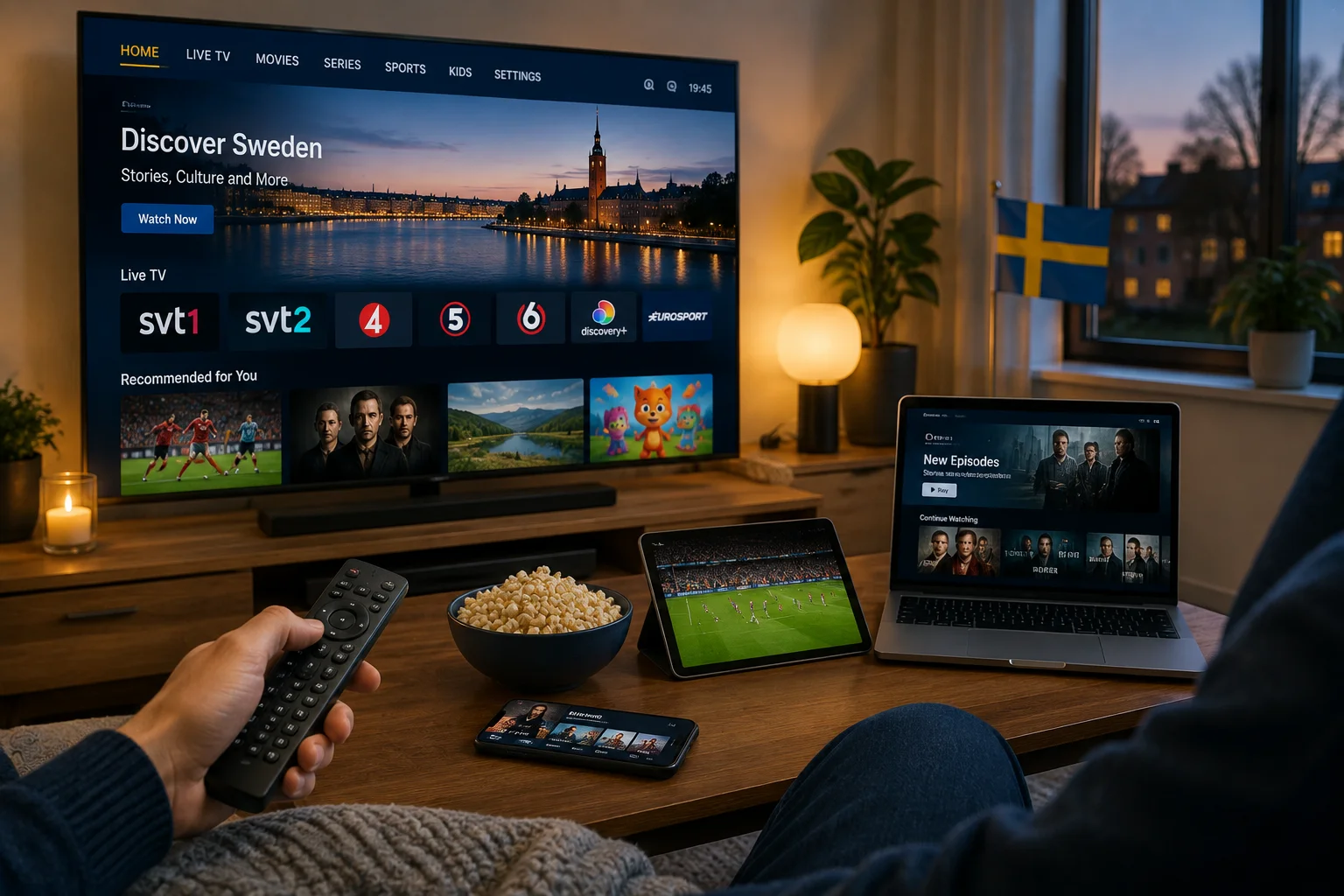
Swedish viewers are moving from cable and satellite to internet television because of the country’s strong fibre infrastructure, the flexibility of watching on any device and any schedule, rising cable costs, and the appeal of consolidating multiple subscriptions into fewer services. Internet TV, including streaming apps and IPTV, now fits how people in Sweden actually want to watch.
Walk into a Swedish household a decade ago, and the TV was the fixed point, one screen, a cable box, a schedule to work around. Walk into one today, and the picture is completely different. The phone, the tablet, the laptop, and the TV all show the same content, and none of it arrives through a cable in the wall.
This shift isn’t a quiet trend anymore. Internet television has become the default way a growing share of Sweden watches, and the reasons behind it are worth understanding, whether you’ve already made the switch or you’re still weighing it.
What “Internet TV” Actually Means
The term covers more than one thing, which is part of why it gets confusing.
At its simplest, internet television is any TV content delivered over your internet connection rather than through cable or a satellite dish. That includes the big streaming apps everyone knows, but it also includes IPTV, which brings live channels, sport, and on-demand libraries together over the same internet connection.
The common thread is the delivery method. Instead of a broadcast signal pushed to everyone at once on a fixed schedule, you request what you want, when you want it, and it streams to whatever screen you’re holding. That single change is what makes everything else possible. For a fuller breakdown of how the technology works, our guide to how IPTV works covers it plainly.
Why Sweden Specifically Is Leading the Shift
Cord-cutting is happening across the world, but Sweden has moved faster than most, and there are concrete reasons.
Exceptional fibre infrastructure. Sweden has some of the best broadband coverage in Europe. Fast, reliable internet is close to a given here, which removes the single biggest obstacle to internet TV, a connection that can’t handle it.
A digitally comfortable population. Swedish viewers adopted streaming early and never looked back. Watching on demand, on personal devices, already feels normal rather than novel.
Strong mobile use. With so much viewing happening on phones and tablets, a fixed cable box tied to one room feels increasingly out of step with how people actually live.
Put those together and Sweden isn’t just following the global trend, it’s near the front of it.
The Reasons People Actually Switch
Behind the infrastructure, the day-to-day motivations are practical.
Watching on Your Own Schedule
The biggest one. Traditional TV decides when you watch. Internet TV lets you decide, live when you want it, on demand when you don’t, paused and resumed around your actual life rather than a broadcast timetable.
Every Screen, Not Just the Living Room
One of the clearest breaks from cable. The same content follows you, TV, phone, tablet, laptop, without being chained to a single box in a single room. Start something on one screen, finish it on another.
Cost, and the Subscription Pile-Up
Cable packages are expensive, and often stuffed with channels nobody watches. But there’s a newer frustration too: the streaming pile-up. A separate subscription for films, another for series, another for a specific network, and the total quietly climbs. Part of internet TV’s appeal is consolidation, getting more into fewer services rather than more.
Better Quality, Where the Connection Supports It
With fibre widely available, 4K streaming is realistic for most Swedish households, often matching or beating what traditional broadcast offered.
What This Means for How You Choose
As internet TV becomes the default, the question shifts from whether to switch to what to switch to. And the options aren’t all equal.
The big streaming apps do on-demand well but offer no live TV, and stacking several of them gets expensive. IPTV services combine live channels, sports, and on-demand libraries under one subscription, but they vary enormously in quality. The difference between a service with real server capacity and one competing purely on price shows up the moment you actually rely on it.
Whichever direction you lean, the things worth checking are the same: does it hold up at peak times, does it cover what you actually watch, and is the pricing honest. Our guide to the features worth looking for walks through the full checklist, and if you’re specifically weighing IPTV, the complete IPTV Sverige guide covers everything for a Swedish viewer.
Frequently Asked Questions
What is internet television?
TV content delivered over your internet connection instead of cable or satellite. It includes streaming apps and IPTV, letting you watch on any device, on your own schedule.
Why are Swedish viewers switching from cable to internet TV?
Strong fibre infrastructure, the flexibility of watching on any device and schedule, rising cable costs, and the appeal of consolidating multiple subscriptions into fewer services.
Is internet TV better than cable in Sweden?
For many viewers, yes, more flexibility, multi-device access, on-demand alongside live TV, and often lower cost. Whether it suits you depends on how you watch.
What internet speed do I need for online TV in Sweden?
Around 25 Mbps for Full HD and 50 Mbps or more for 4K. Most Swedish fibre connections comfortably exceed this. More detail here.
Can I watch live TV over the internet, not just on-demand?
Yes. Streaming apps focus on on-demand, but IPTV services combine live channels with on-demand libraries on one subscription.
Do I need special equipment for internet TV?
No. A Smart TV, phone, tablet, Fire Stick, or computer with an internet connection is enough, no cable box or dish required.